
Revocation of International Status for IMIP Special Airport: Conflict Between Investor Commitments and National Sovereignty?

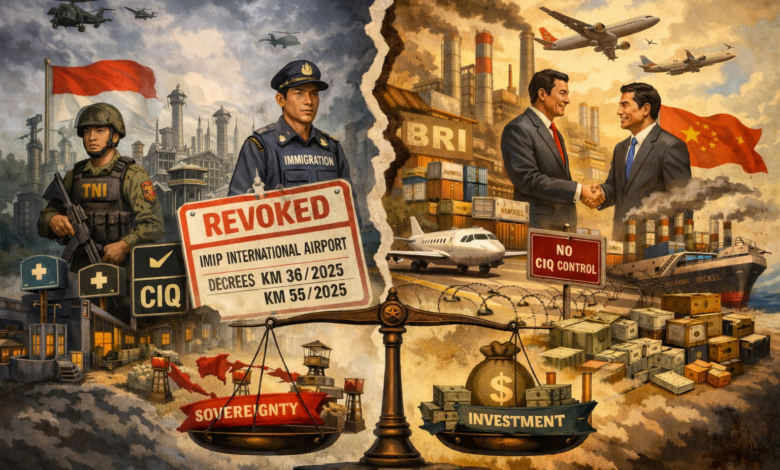
Only by shifting from a reactive ‘viral-based’ policy to a proactive-standardized system can Indonesia guarantee that investment facilities remain anchored in the rule of law and national dignity.
Indra Jaya Gunawan/Indonesia
In late 2025, Indonesian Minister of Defence, Sjafrie Sjamsoeddin, flagged operational ‘anomalies’ at the Indonesia Morowali Industrial Park (IMIP) Airport, explicitly asserting that a ‘state within a state’ is impermissible. This critique stemmed from observations that IMIP Airport, a special private airport owned by PT Indonesia Morowali Industrial Park, conducted logistical activities devoid of essential state security apparatuses, including the TNI, Polri, and Customs, Immigration, and Quarantine (CIQ) elements. This regulatory vacuum is perceived as a potential conduit for illicit activities. The controversy is underscored by regulatory volatility, which IMIP Airport was initially authorised for direct international flights under Minister of Transportation Decree No. KM 38 of 2025, only to have this status abruptly revoked less than two months later via Decree No. KM 55 of 2025. This rapid policy reversal highlights a profound lack of legal certainty regarding the operational status of private-sector special airports.
The Purpose of IMIP Airport Construction and Its Benefits in Supporting the Economy
PT IMIP serves as Indonesia’s colossal industrial hub for nickel-based commodities, representing strategic partnership between Indonesia’s BintangDelapan Group and China’s Tsingshan Group. As a cornerstone of China’s Belt and Road Initiative (BRI) in Indonesia, IMIP functions as both a global nickel production pioneer and a diplomatic symbol of China-Indonesia economic business partnership. The significance of IMIP intensified following the government’s nickel downstreaming policy based on Minister of Energy and Mineral Resources Regulation Number 11 of 2020. As one of the National Strategic Project (PSN) with a USD 34.3 billion investment-worth accumulated until 2024, IMIP’s control over 90% Indonesia’s nickel reserves and its vast socio-economic multiplier effect render it an indispensable pillar of national industrial stability and global supply chain dominance.
To facilitate technology transfer and support high-priority industrial activities, the government granted IMIP non-fiscal incentives, called “facilities” under Law No. 25 of 2007, which include the operation of its own private special airport, differing from Morowali Airport which intended for public commercial services. While offering economical facilities to major investors is common practice, these benefits must strictly follow the regulations and never conflict with existing law. Consequently, this airport serves as pivotal gateway that holds strategic role in both IMIP’s operations and also broader national economy impacts.

Source: https://voicesulsel.com/pakar-pertahanan-soroti-bandara-imip-morowali-diduga-tertutup-dari-otoritas-indonesia/
Types of Airports and Their Designations
The Indonesian Aviation Law No. 1 of 2009 bifurcates airports into two categories: General Airports which serving public interests, and Special Airports utilized exclusively for private business activities. IMIP Airport falls into the latter category, analogous to specialized facilities operated by entities such as PT Freeport Indonesia or Chevron.
A critical legal question arises regarding flight routes; while Special Airports can serve international flights under specific conditions (Article 47, Government Regulations No. 70 of 2001), Article 256 of the Aviation Law implies that any airport with international status must host CIQ personnel. Consequently, granting international flight rights to a special airport without immediate state oversight constitutes a fundamental breach of sovereign protocols. In this context, granting IMIP Airport international status without establishing state oversight, followed by a swift revocation, leaves a legal paradox that questions the normative basis of the government’s initial decision.
The Pendulum of International Status: Policy Fluctuation
The legal debate intensified when Decree KM 38/2025 designated IMIP as temporary international gateway, requiring immediate deployment of CIQ personnel. However, the revelation of a ‘gatekeeper-less’ entry point led to the issuance of Decree KM 55/2025 just months later, stripping IMIP of its international status to ensure security compliance. This rapid fluctuation between granting and revoking international status raises a significant jurisprudential question regarding the normative justification for the initial permit.
From Indonesian administrative law perspective, this policy reversal constitutes a breach of the General Principles of Good Governance, specifically the principle of legal certainty. Such an ‘error-state’ in ministerial decision-making not only undermines the state’s integrity in managing its borders, but also harms the investor’s long-term reliance on Indonesian law. By failing to provide a stable regulatory framework, Indonesia government itself creates legal uncertainty that threatens the balance between investment facilitation and sovereign oversight.
National Sovereignty vs Investment Interests
While prioritizing investor interests is essential for foreign exchange and national development, economic growth must no undermine national sovereignty. Sovereignty concept is non-delegable, the state’s de jure right to manage resources is meaningless without its de facto control over gateways. The IMIP case reveals a dangerous status-function discrepancy, where the administrative granting of international status exists without the mandatory presence of state oversight. This regulatory inconsistency results in a ‘gatekeeper-less’ entry point, leaving the territory vulnerable to the unauthorised movement of goods and resources into the country.
To achieve a sovereignty-investment equilibrium, Indonesia government must ensure that investment facilities do not operate in a vacuum of state authority. Territorial and economic sovereignty must exist in harmony, where legal certainty for investors is balanced by absolute state oversight. Ultimately, every sovereign concession granted for economic interest must be accompanied by firm regulatory enforcement to guarantee that the output of investment genuinely serve the public welfare without compromising the dignity of the nation.
The fact that this controversy only surfaced following viral media coverage and intervention by the Minister raises critical questions regarding the effectiveness of sectoral oversight. Such reactive law enforcement, possibly executed only after public outcry, indicates a failure in the ‘built-in’ monitoring systems. To address these flaws, the government must prioritize to harmonise the regulatory framework, specifically targeting the aviation regulations on special airports. Government may mandate the integration of flight tracking system at special airports with national civil aviation and air defense authorities. Furthermore, state oversight must be applied universally and consistently, plus be backed by uncompromising enforcement. State must take firm action by imposing sanctions or revoking permits for any violation of the rules. Only by shifting from a reactive ‘viral-based’ policy to a proactive-standardized system can Indonesia guarantee that investment facilities remain anchored in the rule of law and national dignity.
***
Indra Jaya Gunawan, S.H., M.H. is lecturer at the Civil Law Laboratory, Faculty of Law, UBAYA – Lecturer of Transportation Law. He completed his Bachelor’s degree in 2018 at the Faculty of Law Universitas Surabaya and his Master’s degree at the same university in 2021. He is active in writing and researching legal topics related to aspects of civil law and technology.