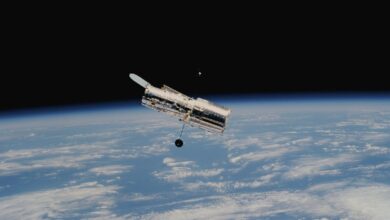


Space debris used to sound like a distant, technical concern. Today, it is increasingly a global governance and safety problem, because modern life depends on satellites and the environment they operate in is getting more crowded, more complex, and harder to protect.
Space debris refers to human-made objects in orbit that no longer serve a useful purpose: dead satellites, spent rocket stages, fragments from explosions, and shards created by collisions. Once something becomes debris, it does not politely “stay out of the way.” It keeps orbiting at extreme speeds, turning even tiny pieces into serious hazards.
The Numbers Are Moving in the Wrong Direction
Earth’s orbital environment is a finite resource, and the amount of debris in it keeps increasing. The European Space Agency (ESA) reports that around 35,000 objects are currently tracked in orbit; roughly 9,100 are active payloads, while about 26,000 are debris larger than 10 cm. ESA also estimates that objects larger than 1 cm (large enough to cause catastrophic damage) exceed one million.

NASA’s Orbital Debris Program Office provides another sobering lens: more than 25,000 objects larger than 10 cm are known, the estimated population between 1–10 cm is about 500,000, and the number of particles larger than 1 mm exceeds 100 million.
These figures matter because even if we can track many large objects, a significant portion of the most dangerous debris is too small to track reliably but still energetic enough to disable a spacecraft.
Speed Turns “Small” Into “Catastrophic”
In low Earth orbit, objects travel at roughly 7–8 km/s, and typical impact speeds can be around 10 km/s (and even higher). At those speeds, a collision is not a bump, it is an explosion of kinetic energy.
This is why debris is not just clutter. It is an evolving hazard field that forces active satellites to maneuver more often to avoid conjunctions, and it increases operational costs for everyone. ESA notes that collision avoidance maneuvers are becoming increasingly unavoidable as congestion and debris grow.
Debris Lasts a Long Time
Debris is also persistent. How long it stays in orbit depends heavily on altitude. NASA notes that debris below about 600 km often reenters within years, but at around 800 km it can remain for centuries, and above 1,000 km it can persist for a thousand years or more.
That means “we’ll clean it up later” is not a plan. In many orbits, later is effectively never.
Collisions Create More Debris (The Cascade Risk)
A major fear is a runaway feedback loop: collisions generate fragments, fragments increase the probability of further collisions, and the environment degrades over time. ESA explicitly warns that if trends continue, catastrophic collisions could rise significantly, potentially leading to a cascading effect often referred to as Kessler syndrome, where certain orbits become unsafe and unusable.
This is one reason space debris is a global problem. Debris does not respect borders, flags, or business models. One fragmentation event can raise risks for all operators sharing that orbital band.
What Creates the Biggest Debris Events?
Not all debris is created equally. Large debris increases significantly when there are major breakups. NASA points to explosions and collisions as principal sources of large debris, and notes that events such as the 2007 Fengyun-1C destruction and the 2009 Iridium–Cosmos collision dramatically increased the cataloged debris population.
In other words: a small number of major events can reshape the risk landscape for decades.
Why This Is Becoming a Global Problem Now
Three shifts are turning debris into a bigger governance challenge than ever:
First, there are more satellites and more launches than before, including large commercial constellations concentrated in specific altitude ranges. ESA highlights especially dense bands in low Earth orbit, where a large share of active satellites cluster.
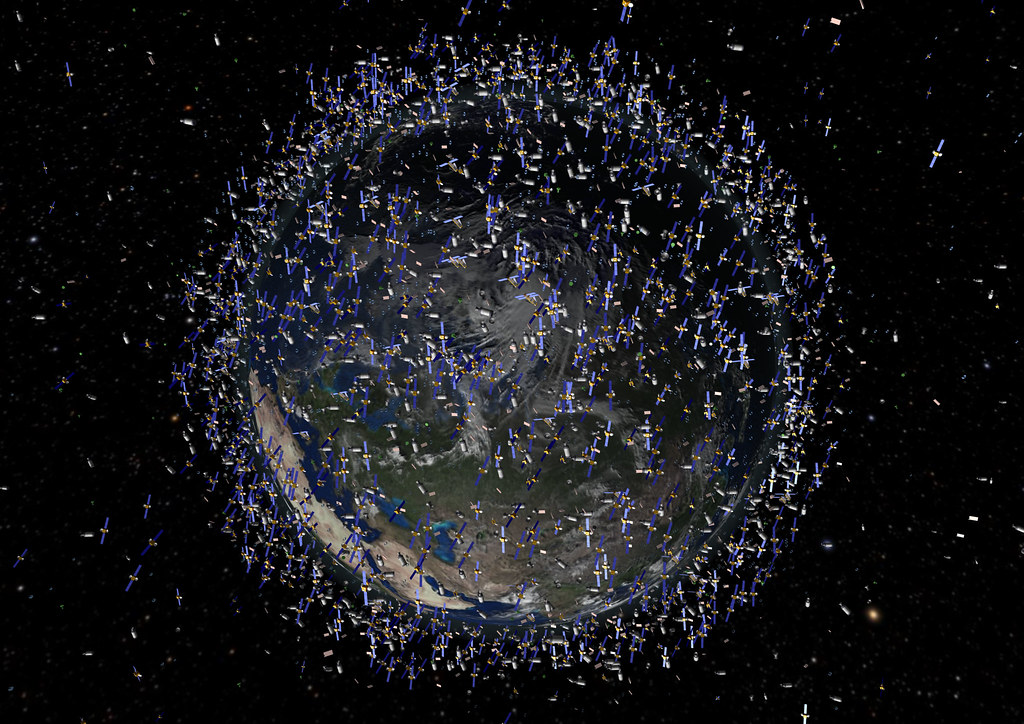
Second, debris is increasingly a systems risk. Satellite services support navigation, timing, communications, weather forecasting, and disaster monitoring. When the orbital environment deteriorates, the cost and reliability of these services can be affected.
Third, debris mitigation is improving, but not enough to reverse the overall trend. ESA’s assessment is blunt: without further change, collective behavior is unsustainable in the long term.
The Governance Gap: Rules Exist, But Compliance Is the Hard Part
International guidance exists, including widely recognized debris mitigation guidelines developed through international coordination. The UN’s space debris mitigation guidelines were adopted through the COPUOS process in 2007, and the Inter-Agency Space Debris Coordination Committee (IADC) has also issued consensus mitigation guidance.
But guidelines do not automatically produce outcomes. The challenge is consistent implementation across different national regulatory systems, operators with different incentives, and fast-growing commercial activity.
What “Solving” the Debris Problem Actually Means
No single action fixes debris. The practical path is layered:
- Stop adding unnecessary debris: better design, safer operations, passivation of rocket stages, and preventing explosions.
- End-of-life disposal that actually happens: moving defunct objects out of crowded operational zones and ensuring timely reentry where feasible.
- Better coordination and transparency: more reliable tracking data-sharing and improved collision avoidance coordination, especially in highly congested orbital shells.
- Targeted remediation: active debris removal is difficult and expensive, but may be necessary for the highest-risk objects in key orbits